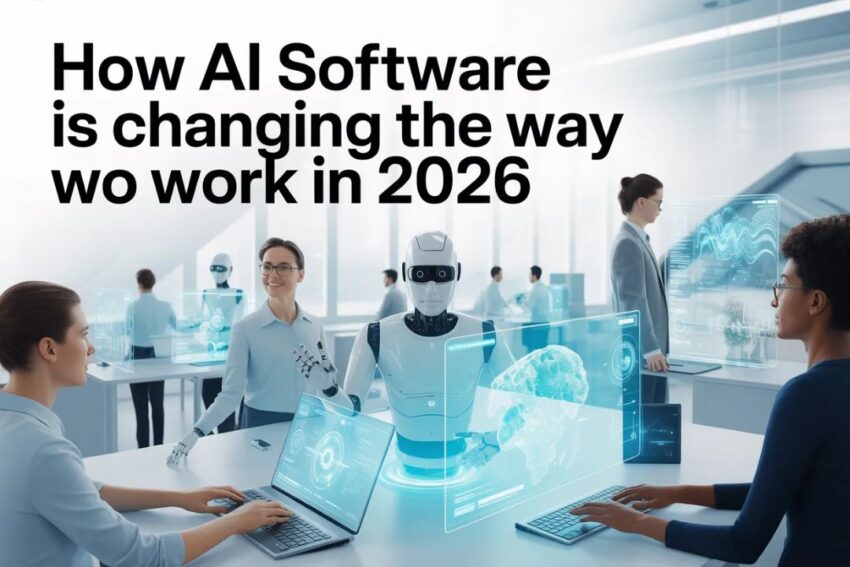
The Rise of AI in the Modern Workplace
Rapid Growth of AI Adoption
Artificial intelligence has moved from experimental technology to a core part of business infrastructure. In 2026, companies are no longer asking whether they should adopt AI—they are asking how fast they can integrate it into every workflow. Studies show that 77% of businesses are already integrating AI into their operations, while roughly one-third have fully implemented AI solutions across departments.
This surge in adoption has been driven largely by the rise of generative AI tools, which can write text, generate images, analyze data, and even produce code. Unlike older automation software that required complex programming, modern AI tools are easy to use. Employees simply type a prompt, and the system performs complex tasks within seconds.
Another factor driving this rapid expansion is accessibility. AI platforms are now integrated into everyday workplace software—email apps, office suites, project management tools, and customer service platforms. Employees can use AI without needing advanced technical skills.
Interestingly, many workers are already experimenting with AI independently. Surveys show that 72% of professionals report using AI at work, sometimes even without official approval from their companies. This phenomenon, sometimes called “shadow AI,” highlights how quickly employees have embraced these tools.
AI is no longer an optional technology experiment. It is becoming a fundamental part of modern productivity.
Why Businesses Are Investing in AI
Organizations are investing billions into AI because the benefits are hard to ignore. One of the biggest advantages is efficiency. Companies report dramatic improvements in productivity when AI handles routine tasks such as document generation, data processing, and customer support responses.
Statistics show that 64% of businesses believe AI will significantly increase productivity, making it one of the most important technology investments of the decade. When employees spend less time on repetitive tasks, they can focus on strategy, creativity, and problem-solving.
Cost reduction is another major incentive. AI systems can automate tasks that previously required multiple employees or outsourced workers. Some research indicates that companies are gradually replacing certain outsourced tasks with AI services because of the potential cost savings.
Competitive pressure also plays a role. When one company adopts AI to speed up product development or improve customer service, competitors must follow to remain competitive. The result is an AI adoption race across industries.
This dynamic has transformed AI from an experimental technology into a business necessity. Organizations that fail to adopt AI risk falling behind their competitors in productivity, innovation, and customer experience.
Key Types of AI Software Used at Work
Generative AI Tools
Generative AI is perhaps the most visible form of AI in the workplace today. These systems can create text, images, audio, and even video based on simple instructions. For office workers, generative AI acts like a digital assistant that can draft reports, write emails, summarize meetings, and generate creative ideas.
Employees often rely on generative AI for tasks such as:
- Writing marketing content
- Creating reports and documentation
- Summarizing research
- Drafting business proposals
- Generating software code
Because of these capabilities, generative AI tools have quickly become everyday productivity tools. Surveys suggest that more than 71% of organizations now use generative AI in at least one business function.
The real power of generative AI lies in its ability to handle complex language tasks. Instead of spending hours drafting documents or analyzing long reports, employees can ask AI to generate summaries or first drafts instantly. This dramatically reduces the time required for many knowledge-based tasks.
Generative AI also helps employees overcome creative blocks. Whether someone is writing a marketing campaign or brainstorming new product ideas, AI can provide suggestions and inspiration.
Automation and Workflow AI
Another major category of workplace AI involves automation. While generative AI focuses on creating content, automation AI focuses on handling repetitive processes.
Examples include:
- Customer service chatbots
- Automated invoice processing
- Scheduling and calendar management
- Data entry automation
- Inventory management systems
These tools reduce human workload by performing tasks that follow predictable rules. Instead of manually entering data or responding to simple customer inquiries, employees can focus on more complex work.
Automation AI also improves consistency. Machines do not get tired or distracted, meaning repetitive tasks can be performed with greater accuracy and reliability.
In many industries, automation has already transformed workflows. Customer service teams now use AI chatbots to handle basic questions, while human agents focus on more complex customer issues.
AI Analytics Platforms
Data has become one of the most valuable resources in modern business. However, analyzing massive datasets manually is time-consuming and often impractical. AI analytics platforms solve this problem by automatically identifying patterns, trends, and insights within large datasets.
These systems help businesses:
- Predict customer behavior
- Detect fraud and anomalies
- Optimize supply chains
- Improve marketing strategies
- Forecast financial trends
AI analytics tools allow companies to make decisions based on real-time data rather than intuition alone. This data-driven approach often leads to better business outcomes.
Many organizations now integrate AI analytics into everyday operations. For example, retail companies use AI to predict demand and manage inventory, while financial institutions rely on AI to identify suspicious transactions.
How AI Improves Productivity
Automating Repetitive Tasks
One of AI’s most powerful benefits is its ability to eliminate repetitive work. Tasks that once required hours of manual effort can now be completed within seconds.
Consider tasks like data entry, email sorting, document formatting, and meeting scheduling. These activities are necessary for business operations, but they rarely require creativity or strategic thinking. AI can perform them efficiently, freeing employees to focus on more valuable tasks.
Studies indicate that workers who use AI tools regularly can save several hours per week. In some cases, employees report saving up to a few hours per day through AI-assisted workflows.
This shift fundamentally changes how work is structured. Instead of spending most of their time on routine tasks, employees can focus on innovation, strategy, and collaboration.
Faster Decision Making
Another important benefit of AI is faster decision-making. In traditional workplaces, analyzing data and preparing reports can take days or even weeks. AI systems can process massive datasets within seconds, providing immediate insights.
This speed allows companies to respond quickly to market changes. For example, retailers can adjust pricing based on real-time demand, while logistics companies can optimize delivery routes instantly.
AI also reduces human bias in decision-making by relying on data rather than intuition. While human judgment remains important, AI provides objective insights that support better decisions.
AI and Remote Work Evolution
AI Collaboration Tools
Remote work has become a permanent part of modern business culture. AI tools have played a major role in making distributed teams more efficient.
Collaboration platforms now include AI features that automatically summarize conversations, track project progress, and suggest next steps. Instead of manually reviewing long chat threads or meeting notes, employees can rely on AI-generated summaries.
This improves productivity and reduces communication overload. Teams can stay aligned without spending excessive time reviewing information.
AI Meeting Assistants
Meetings are notorious productivity killers. Employees often spend hours in meetings, yet important information is easily forgotten or misunderstood.
AI meeting assistants are solving this problem. These tools automatically record meetings, generate transcripts, summarize key points, and assign action items.
Employees no longer need to take extensive notes during meetings. Instead, they can focus on the discussion while AI captures all the important details.
Industries Most Impacted by AI
Technology and Software Development
The technology sector has been one of the earliest adopters of AI tools. Developers now use AI coding assistants to write and debug software more efficiently.
Research suggests that up to 97% of IT workers use generative AI tools, highlighting how deeply AI has integrated into software development workflows.
These tools can generate code snippets, detect bugs, and recommend improvements. As a result, developers can build software faster and with fewer errors.
Finance and Business Operations
Financial institutions rely heavily on data analysis, making them ideal candidates for AI adoption. AI systems can analyze financial transactions, detect fraud, and predict market trends.
Many banks and financial firms now use AI to automate compliance checks and risk assessments. This improves accuracy while reducing operational costs.
Healthcare and Research
Healthcare is another industry experiencing significant AI transformation. AI systems assist doctors with diagnostics, medical imaging analysis, and drug discovery.
Researchers can analyze large datasets much faster with AI tools, accelerating scientific breakthroughs.
The Changing Job Market
Jobs at Risk of Automation
As AI adoption grows, concerns about job displacement have increased. Some reports suggest that certain roles—such as data entry, programming assistance, and customer service—could see up to 70% of tasks automated by AI technologies.
Routine and repetitive roles are most vulnerable because AI excels at structured tasks.
New Careers Created by AI
While some jobs may disappear, AI is also creating entirely new career paths. Examples include:
- AI engineers
- Prompt engineers
- AI integration consultants
- AI ethics specialists
- Machine learning researchers
Professionals with AI-related skills often earn significantly higher salaries. In fact, workers with AI expertise can earn about 40% more than those without it.
Skills Workers Need in the AI Era
To succeed in the AI-driven workplace, employees must develop new skills. Technical knowledge is important, but soft skills remain equally valuable.
Key skills for the AI era include:
- AI literacy – understanding how AI tools work
- Critical thinking – evaluating AI-generated outputs
- Creativity – generating innovative ideas beyond automation
- Data interpretation – understanding AI insights
Workers who combine human creativity with AI tools will have the greatest advantage.
Ethical Challenges and Concerns
Despite its benefits, AI also raises serious ethical concerns. Issues such as data privacy, algorithmic bias, and job displacement must be addressed.
Another challenge is accuracy. AI systems sometimes produce incorrect or misleading information. Surveys show that more than half of employees do not always verify AI outputs, which could create serious risks for businesses.
Organizations must implement clear guidelines to ensure responsible AI use.
The Future of Work With AI
Looking ahead, AI will continue to reshape the workplace. Experts believe that within the next decade, AI will be deeply integrated into almost every profession.
Instead of replacing humans entirely, AI will likely act as a collaborative partner that enhances human capabilities.
The future workplace will likely involve humans and AI working side by side, combining machine efficiency with human creativity.
Conclusion
Artificial intelligence has moved from a futuristic concept to a daily workplace tool. In 2026, AI software is transforming how people write, analyze data, collaborate, and make decisions. Businesses are adopting AI at unprecedented speed because it increases efficiency, reduces costs, and unlocks new opportunities.
Although concerns about job displacement remain, AI is also creating new careers and empowering workers with powerful tools. The key to success in this new environment is adaptability. Employees who learn how to use AI effectively will have a major advantage in the evolving job market.
The workplace of the future will not be defined by humans or machines alone. Instead, it will be shaped by the partnership between human intelligence and artificial intelligence.
FAQs
1. What is AI software used for in the workplace?
AI software helps automate tasks, analyze data, generate content, improve customer service, and support decision-making.
2. Will AI replace human workers completely?
Most experts believe AI will transform jobs rather than completely replace them. Many roles will evolve instead of disappearing.
3. Which industries are most affected by AI?
Technology, finance, healthcare, manufacturing, and customer service are among the industries experiencing the largest AI transformations.
4. What skills are important in an AI-driven workplace?
AI literacy, data analysis, creativity, critical thinking, and problem-solving are key skills for the future workforce.
5. How can workers prepare for the AI future?
Workers should learn how to use AI tools, stay updated on technological trends, and continuously develop both technical and soft skills.